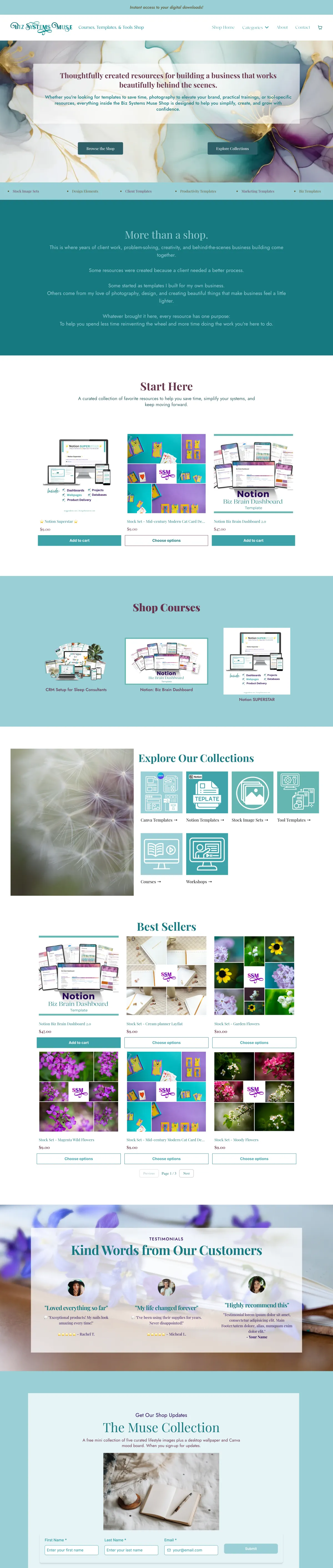
The Shop is almost ready and
will be launching on August 10th 🎉
Programs
Specifically Crafted for Sleep Consultants
Get step-by-step guidance & support
while you buildout your CRM.
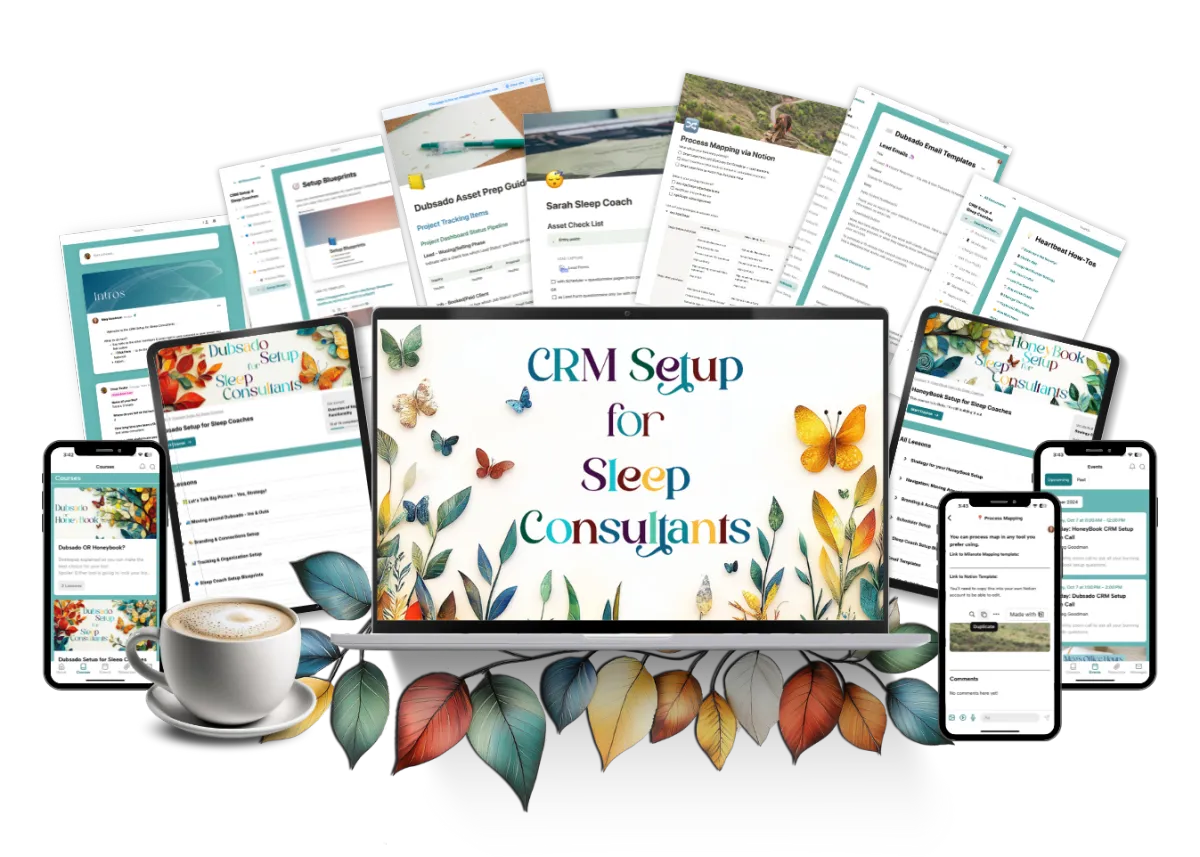
Step-by-step setup video training courses for Dubsado & HoneyBook (+ CRM strategy course, if you are undecided on your tool), Sleep Consultant setup blueprints, and direct access to Meg inside the community platform. Office hours & monthly Q&A video call to get on-going support when you need it.
Flexible community membership - stay for as long as you need support.
Courses & community are all in the same platform.
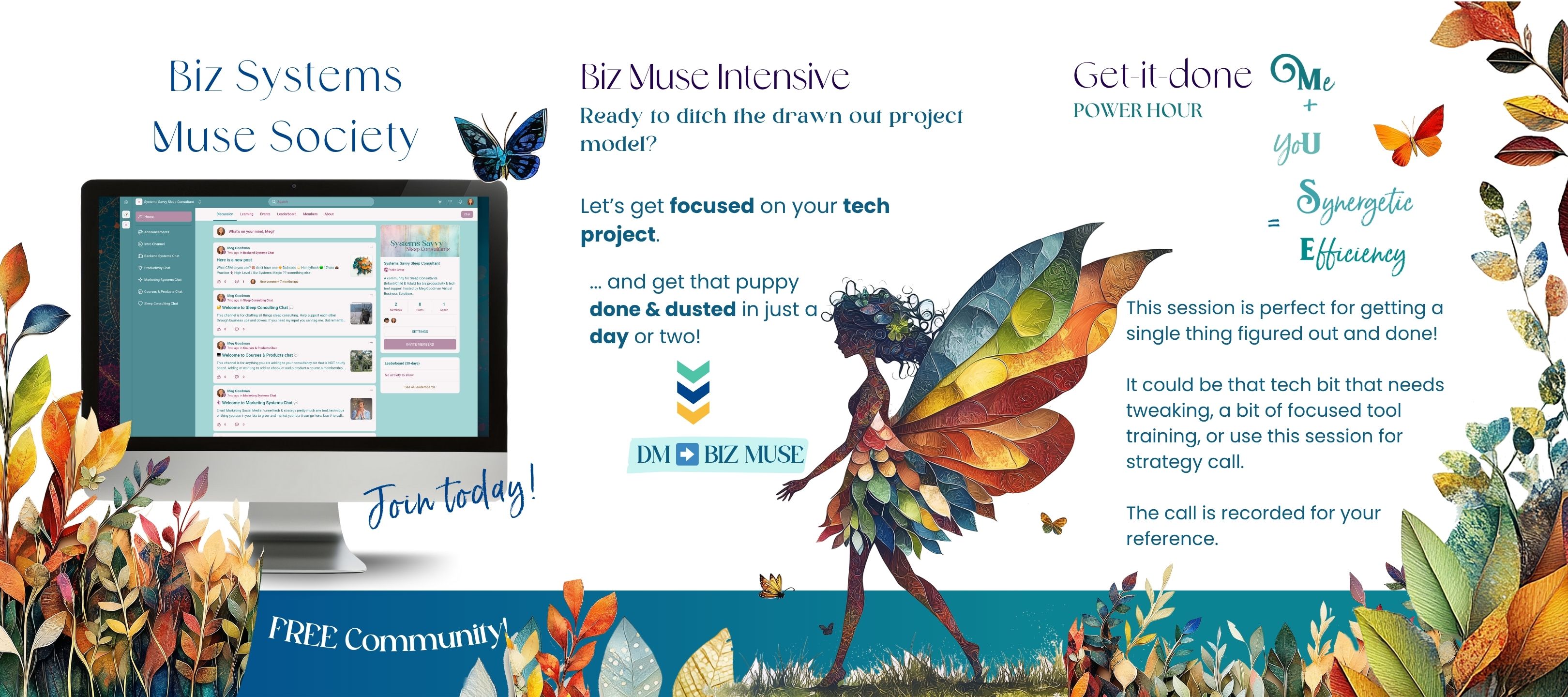
Free Community
Small Call to Action Headline
Your Paragraph text goes Lorem ipsum dolor sit amet, consectetur adipisicing elit. Autem dolore, alias, numquam enim ab voluptate id quam harum ducimus cupiditate similique quisquam et deserunt, recusandae. here
Free Community
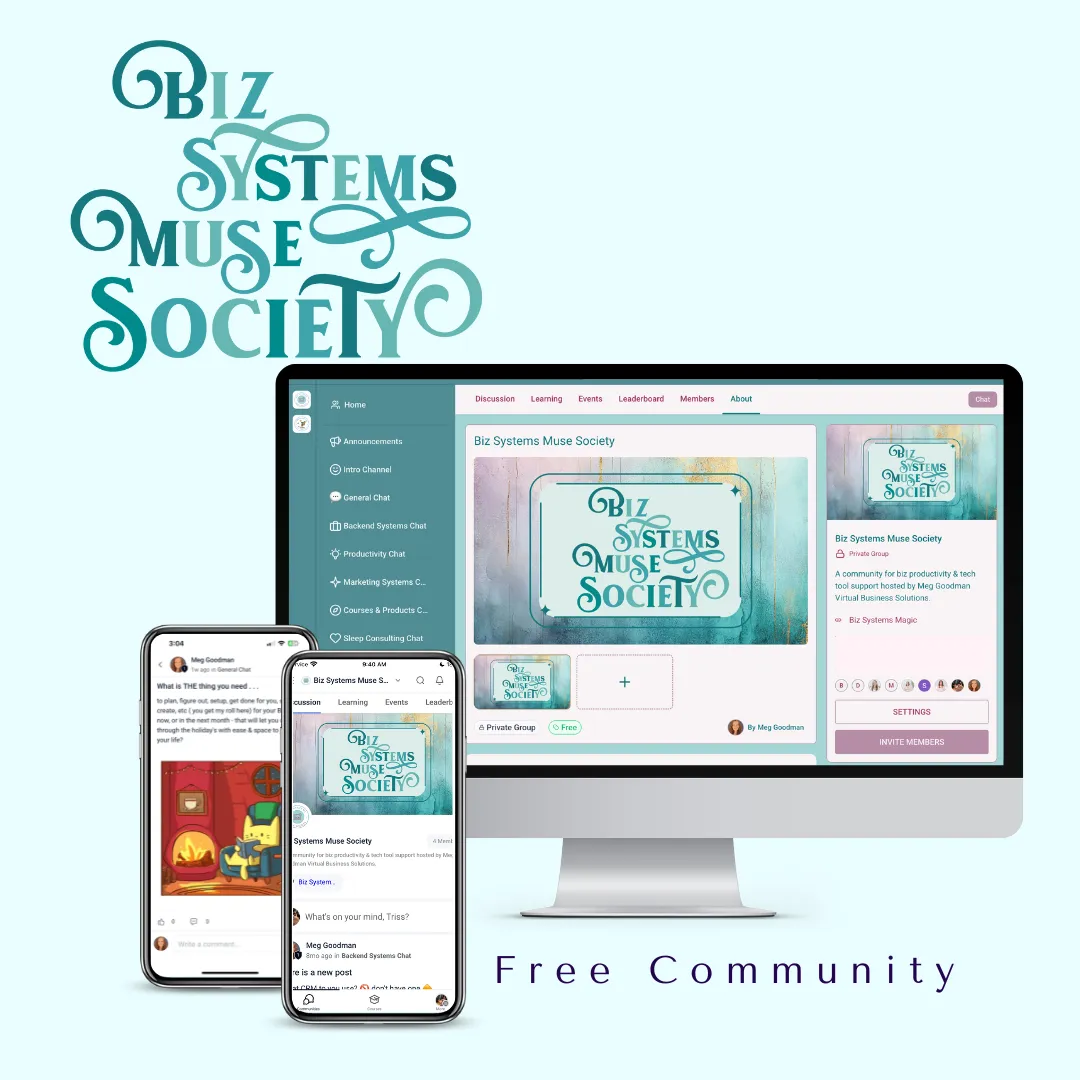
Don't stay in your Solopreneur Silo
Come join my free community and get help with all the ups and downs of running an online biz.
Community is off Facebook and open to all types of systems, software, marketing and biz operations strategy & tech questions.
Products
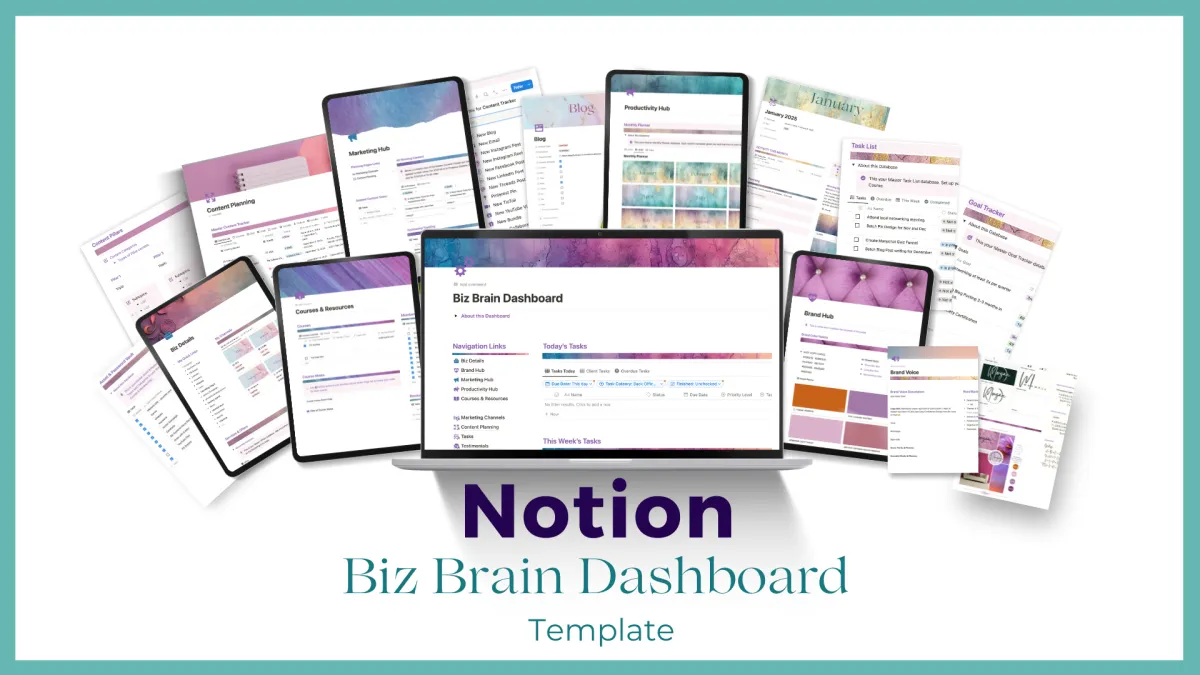
Notion: Biz Brain Dashboard
Introducing the Notion Biz Brain Dashboard, your ultimate solution to experiencing less stress in managing your business!
Designed specifically for entrepreneurs who struggle with seeing the big picture of their business planning and marketing, this Notion template boosts your productivity and organization. With its intuitive layout and powerful features, you'll easily track goals, streamline tasks, and visualize your entire strategy—all in one place.
Say goodbye to overwhelm and hello to a clearer, more focused path to success!
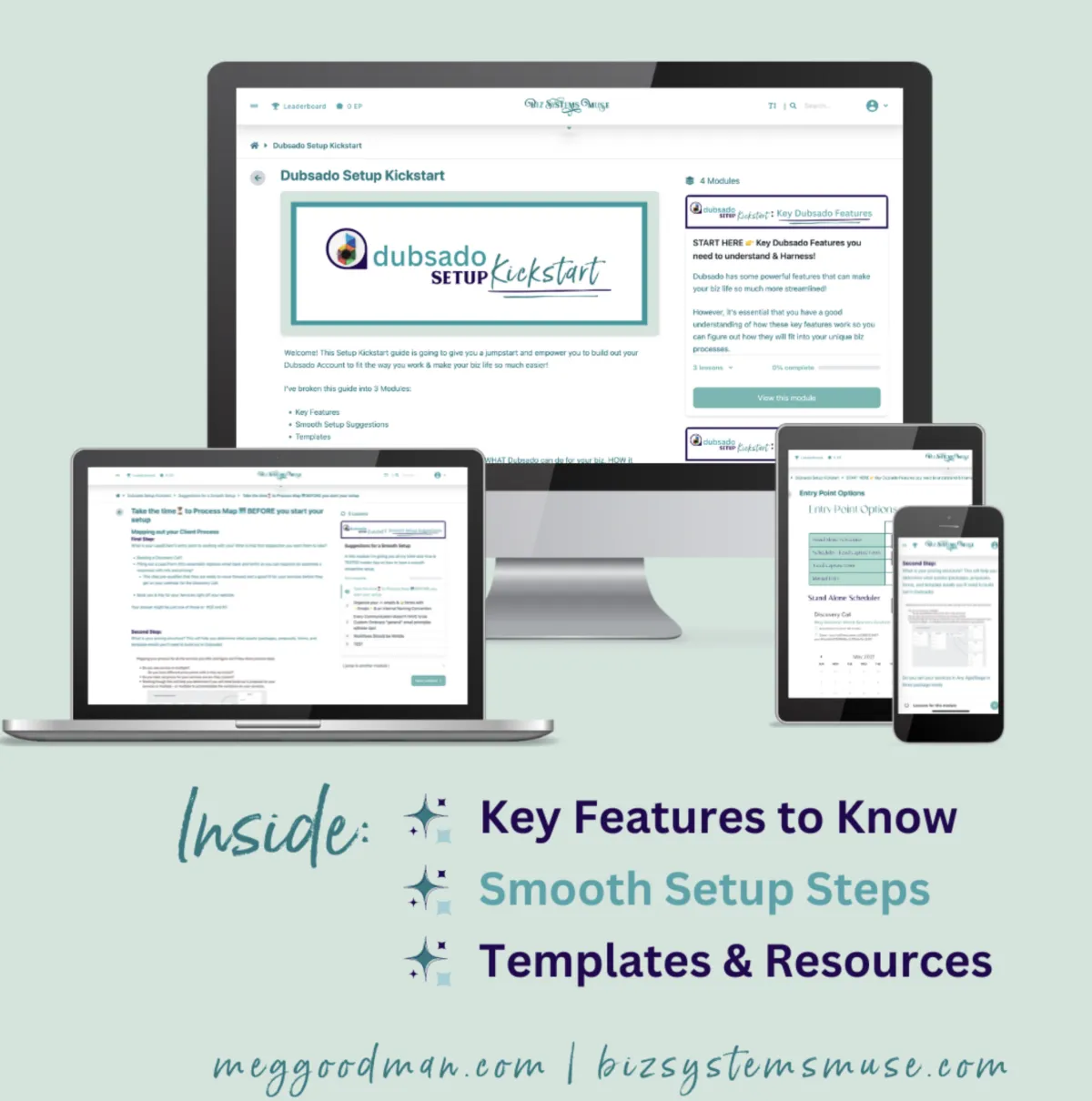
Dubsado Setup Kickstart
Get your Dubsado whipped into shape with this Setup Kickstart Guide!
Inside you'll find:
Training on the Key Features it's important to understand before you begin your setup journey.
Tried-and-true suggestions for a smooth setup (tested & perfected over the years of my experience setting up Dubsado and other CRM).
Templates and resources to get you using Dubsado right away!
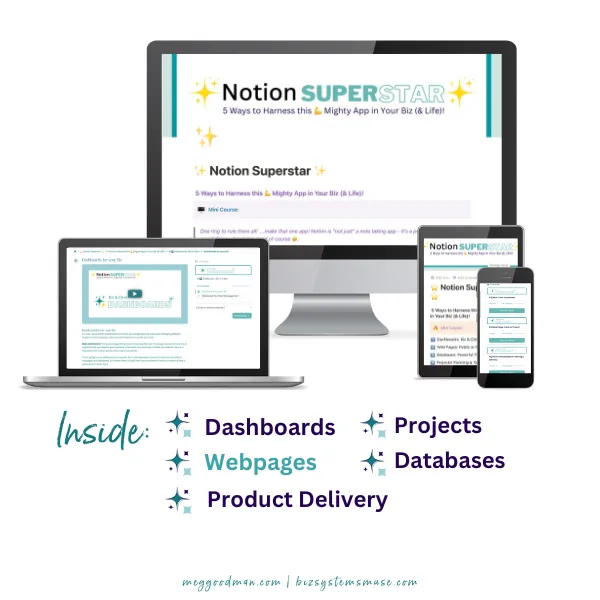
Notion SuperStar ⭐️
5 Ways to Harness this 💪 Mighty App
in Your Biz (& Life)!
One ring to rule them all! ...make that one app! Notion is "not just" a note taking app - it's a powerhouse of possibilities ...for doing good of course 😉.
This mini course will give you an overview of 5 ways to harness this amazing tool to streamline your biz backend as well as ways to use it for free & paid content delivery.
Looking for my 1:1 Services?
Check out my Done-for-You service
⬇️
We can knock it out in a day or two!

You Picked the Best Tool for Every Job. So Why Do the Tools Feel Like the Job?
You Picked the Best Tool for Every Job. So Why Does Running Your Business Feel Like Managing the Tools?
There's a version of this story you probably know well.
You didn't just pick tools randomly.
You researched, read the comparison articles, watched the YouTube reviews, and asked in the Facebook groups.
You picked the best
website platform,
the best email platform,
the best CRM,
and the best course and digital product platform.
You were thoughtful about it, and at the time, every single choice made sense.
And yet here you are, opening your laptop every morning and immediately feeling behind.
Not because you're disorganized or not working hard enough, but because somewhere between the careful tool selection and the actual running of your business, something went sideways.
What nobody told you is that picking the best tool for each job is only half the equation. Managing the gaps between them, the part that quietly became a second job, is the other half.
The Logic That Made Total Sense
For a long time, best-in-class thinking was genuinely the right call.
I did it in my own business, and I recommended it to clients too: pick the CRM with the features you need and actually enjoy working in, pick the email platform that fits how you send, pick the course platform that matches how you deliver.
That was the advice because it was the right advice at the time.
Until a few years ago, the all-in-one category mostly didn't exist for service providers. The tools that claimed to do everything were built for marketers and course creators selling to large audiences, the "gurus" selling big stuff.
They weren't designed for coaches running client journeys, wellness practitioners managing bookings and programs, or consultants who needed a CRM that actually made sense for how they worked.
So we did what made sense: we picked the best tool for each job and figured out the connections as we went.
Then the landscape shifted.
Platforms like GoHighLevel started baking all those core features into one place.
Bigger course platforms added websites, then funnels, then communities. Email marketing tools added checkouts.
Funnels added memberships.
The industry quietly changed while we were busy running our businesses inside the stacks we'd already built, which mostly just added more noise to an already noisy space.
The problem isn't that you made the wrong choices. It's that the industry moved and you're still running on the architecture you built before it did.
The Hidden Second Job Nobody Warned You About
Every integration is a decision point,
every Zap is a dependency,
and every extra tool in your stack is a coordination tax you pay every single month.
Not in money but in mental load, in troubleshooting time, in the low-level anxiety of not being entirely sure everything is talking to each other correctly.
When I was running my business on a stack of carefully chosen tools, I thought I was being strategic. What I was actually doing was building an obstacle course. What I called a workflow was really just a series of workarounds I'd gotten so used to that I stopped noticing they were workarounds.
I wasn't running a business, I was managing my stack.
Here's what that actually looked like:
I had no real way of knowing how big my list was, not because I wasn't paying attention, but because my people were spread across multiple tools.
Clients in one place, leads in another, course students somewhere else, community members somewhere else again, and the same person potentially showing up across three of them with slightly different information in each one.
To get any kind of full picture, I'd have had to manually pull it all together or add yet another tool, a Notion database or an Airtable setup, just to see my own business clearly. And even then, it would have been a snapshot, not a live view.
None of it was catastrophic on its own, but added together, it was exhausting in a way that was hard to explain because on paper I had great tools.
What This Looks Like in Real Life
You might be recognizing yourself here.
You've got multiple tabs open before you've had your first coffee, a client emails with a question and you have to check two different platforms before you can answer with confidence.
Say you want to add a new offer - but the thought of figuring out how to wire it into your existing setup makes you put it off for another month.
You're not scattered. Your architecture is.
The thing about a scattered architecture is that it creates a very specific kind of overhead, one that doesn't show up in your tool costs but absolutely shows up in your energy.
It's the switching, the checking, the second-guessing whether your automations actually fired, the manual tasks you do "just to make sure" because you've been burned before when you trusted the integration to handle it.
You built something that technically works, but "technically works" is doing a lot of heavy lifting, and you're the one carrying it.
The Belief Worth Updating
Best-in-class tools in isolation are only as powerful as the connections between them, and those connections were never really part of the promise. They were the part you were supposed to figure out yourself.
But there's a layer underneath that doesn't get talked about enough:
Even when the integrations work, you still don't have a full picture of your own business.
Your contacts aren't in one place, your revenue isn't in one view, your client history, lead activity, and course completions all live in separate tools with separate dashboards, and the only way to see the whole thing at once is to pull it all into yet another tool or a spreadsheet you update manually and hope stays current.
That's not a tools problem.
That's an architecture problem, and no amount of better integrations fixes it because the fragmentation is baked into the structure itself.
The question isn't whether this is the best tool for this job. The question is whether this gives you a real view of your whole business or just another fragment of it.
Where to Start
If you've never actually mapped what you're running and what it's costing you, that's a genuinely useful place to start. Not to make yourself feel bad about the choices you made, but to see clearly what your current setup is actually doing and what it's asking of you in return.
I built a Tool Stack Audit calculator for exactly this. It takes about five minutes and it shows you the real picture: what you're paying, what you're juggling, and where the hidden costs are sitting. No pitch, just clarity.
If you look at it and something clicks, I'm here. Whether that's a Power Hour to talk through your options or a Mapping Session to actually design what your backend should look like, that's what I do.
Your tools should make your business easier to run. If they're not doing that, it's worth taking a look at why.

“Meg Goodman’s sleep consultant CRM group setup coaching program has been a game changer when it has come to starting and building my business. Meg is awesome. She's very knowledgeable and she is definitely the CRM Guru. I love that she's specifically focusing on helping sleep consultants, I have learned a lot from her.
It has saved me a lot of time when it comes to working with my with my clients because I can focus more on giving sleep support to them because after the program, everything was set up for me. My email automation, invoices, calendars - like you name it! If you're hesitant, I would just jump on board because it's definitely gonna be worth it for your sleep consultant business..”
Amber S. - Sleep-a-Bye Baby
Socials


Socials
© Copyright 2018 - 2026 Meg Goodman Virtual Business Solutions | Terms & Conditions